It’s the Ultimate Disaster Scenario, but How Likely Is It?
A planetary scientist breaks down Don’t Look Up.
By Maria Sherman
Dec. 24, 2021
In the dystopian comedy Don’t Look Up, a comet poses the ultimate threat to life on Earth: If it strikes in six months and 14 days, everything will be destroyed. Like, total apocalypse, extinction for all species-level bad news. (Obviously, it’s a climate change allegory.) It makes for a hilarious film — trust us on that one — but like many of you watching, we’re curious about the likelihood of a space rock crashing into our world and destroying it for good. To fact-check some of the science, we spoke to Dante Lauretta, a regents professor of planetary science and cosmochemistry at the University of Arizona's Lunar and Planetary Laboratory and the leader of NASA's OSIRIS-REx Asteroid Sample Return mission, which tracked one of the most potentially hazardous near-Earth asteroids. Basically, he knows this stuff better than anyone else, and so we had to ask: What is the actual likelihood of a comet destroying the Earth?

Slight spoilers follow.
Don’t Look Up is, among other things, a movie about a comet that is going to strike the Earth and destroy all life on it.
[We] haven’t had a good movie like that in a while.
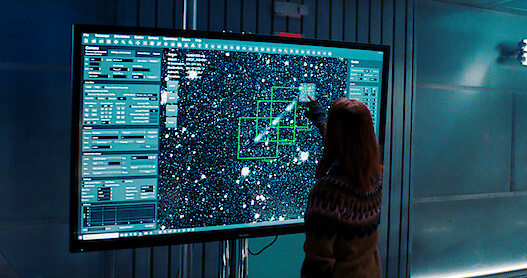
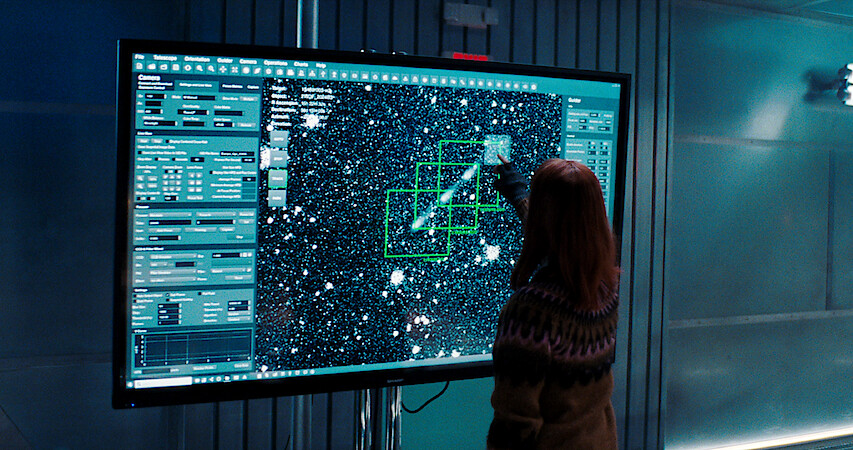
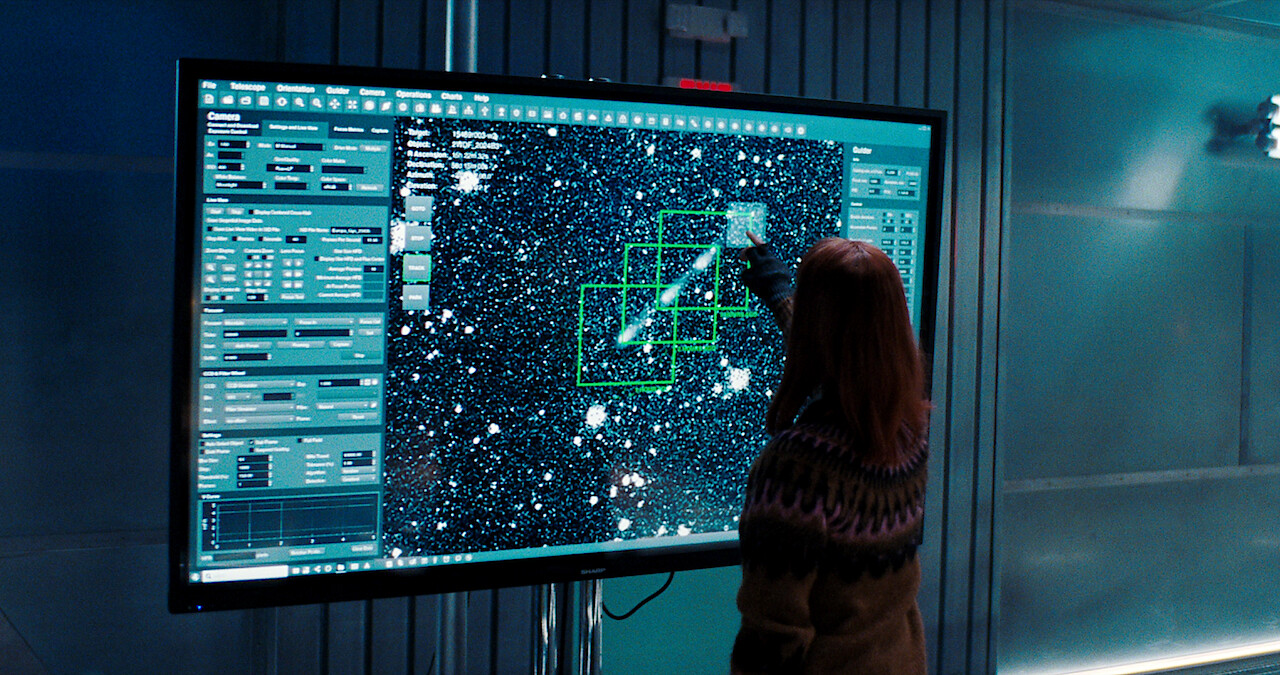
You laugh so you don't cry. It begins with a PhD candidate at Michigan State, Kate Dibiasky, played by Jennifer Lawrence, discovering a new comet from the Oort Cloud. It's cause for celebration, until the team sits down to do some math, or “orbital dynamics,” as her professor, Dr. Randall Mindy (Leonardo DiCaprio), says in the movie. Quickly, they realize that the ephemeris, used to determine the distance between the comet and Earth, keeps getting lower and lower to the point where they ascertain it will collide with the Earth. Is the science right so far? Are comets derived from the Oort Cloud? Is the ephemeris used to determine the distance between a comet and Earth?
Yup, sounds good. Leo knows what he is talking about.
He explains that they used Gauss’s method of orbital determination and average astrometric uncertainty to determine the comet’s trajectory. Are those real things? Is that the correct usage of those terms?
Yep. Sounds great.
Amazing! So, what does it take to identify a new comet? And what would you look for once you've identified it?
The key is a series of follow-on observations. When you discover [a comet], you have a very limited arc. So, if you’re looking at the comet against the background [or] starfield, depending on its orbit, you really need to get a series of observations. You want to look at it over multiple days, multiple weeks, and, ultimately, multiple years, if you can. The uncertainty is going to be a function of how short your arc is, how little of its orbit you actually watched it move across. The longer of a baseline, the tighter the constraint on its future position will be. Usually, when you discover it, it’s unknown what its orbit could be, [so] that you can’t really tell if it’s gonna hit the Earth or not.

Dibiasky tracks the arc and it appears to reveal a pretty severe angle. So I assume it is moving quickly?
Coming in hot.
Exactly. In the film, they say the comet is roughly five to 10 kilometers wide, and that, based on the moment of discovery, it’s scheduled to collide with the Earth in six months and 14 days, “an extinction level event” is what they call it. Would it be, if a comet of that size collided with the Earth? Or is it also dependent on other factors?
No. That would be a bad day. Ten kilometers is roughly comparable to the asteroid that killed the dinosaurs. That’s the similar size range. And if this thing’s a comet, it’s coming in [at a] much higher speed than an asteroid would, typically. Three or four times higher, and it’s squared, so it could be 10 times more devastating than [an] asteroid killing impact. We’d be in trouble. The six months would depend on its orbit. But we would have really had to wait a while if we didn’t catch it until six months out. But, hey, it could happen. These things could have crazy orbits that we didn’t predict until that late… What we’re going to do with a six month lead time is going to be the real question. And, hopefully, they’re not sending Bruce Willis up with a nuclear bomb. I’ve already seen that movie.
What’s the difference between a comet and an asteroid?
Asteroids come from the inner solar system. They typically reside in the asteroid belt between Mars and Jupiter, and they’re composed mostly of rocky material with some metal as well. Comets come in from the outer solar system, like you said, the Oort Cloud. They could be halfway to Alpha Centauri and still be bound to the sun and still become a comet when it falls into the inner solar system. And because they’re so far away, they’re mostly made out of ice.
In the film, there’s a moment where it’s determined that the comet is full of rare, valuable minerals — terbium, osmium, dysprosium — used to build computers and cell phones. How do you determine the elemental makeup of a comet? Do they contain those elements? You said they’re usually ice.
That sounds a little wacky to me. If it were, like, pure osmium, or something like that, it wouldn’t be a comet, because it wouldn’t be creating the coma [the nebulous envelope around the nucleus of a comet] that’s characteristic of a comet. Typically, we look for the composition in the gas phase of the comet. So the ice is sublimating into vapor and gets ionized, and then you can use telescopes to look for very specific frequencies of light [that] would interact with those molecules. You’re looking at water and carbon dioxide and the kinds of things that make up ice in our solar system… If you sent a spacecraft there, you could [figure out the elemental makeup.] I mean, there’d be ways to make those measurements. [But with the OSIRIS-REx Asteroid Sample Return mission], we do talk about mining asteroids and extracting mineral resources and so on.
Certainly. And here’s the biggest question of them all: What’s the likelihood of a comet colliding with Earth?
We don’t have any comet that we’ve identified that is even remotely a risk for an Earth impact, so it’s a little hard to say. We have a much better sense of an asteroid impact because we have lots of asteroids in the inner solar system. Like [with] asteroid Bennu, the target of the OSIRIS REx mission, the odds — and that’s the most likely object that we know of to impact the Earth — that’s 1 out of 1750. A comet is going to be way, way lower than that: less than 1 in 10,000 or 1 in 100,000. But it’s speculative. It’s tricky. Because they come from the outer solar system, they usually only visit the inner solar system for a very brief period of time, especially something from the Oort Cloud. That might not be back for 100,000 years, so we just lose it at that point and we don’t know. So it’s very low. It’s much lower than an asteroid impact. And even though the highest impact [possibility is] asteroid Bennu... let me just do the math here, just to make sure you get it right… it’s a 0.05% chance of impacting in the next 200 years.
Oh, that's reassuring.
I always tell people, “Don’t go out and buy asteroid insurance.”
If Bennu were to impact the Earth, do we know how devastating it would be?
We know a lot about it because we’ve been there with OSIRIS REx. We’ve got [Bennu’s] mass. We’ve got its shape, we’ve got its orbit. It would be [a] 1000-megaton explosion. It would be more energy than every nuclear weapon ever detonated in human history in one location. Instantly. It would be like a city-killing kind of impact, about that scale. It would take out a big city. It wouldn’t end all life, it wouldn’t end civilization. It wouldn’t trigger a nuclear winter, but it would definitely ruin your day.
Is there any way to predict the likelihood of a comet or an asteroid colliding with the Earth and actually destroying all life?
[We have] the geologic record. The asteroid that took out the dinosaurs [is] similar to the one that’s being discussed here. And that happens once every 50 million years to once every 100 million years.
So we shouldn’t worry about it, right?
It was 65 million years ago. We’re in that window where another one could be coming. But, you know, it’s on a million years timescale. So the likelihood of it happening in your lifetime or my lifetime is pretty much zero.
Does the technology exist to stop a comet or asteroid from colliding with Earth? Is there a way to destroy it?
People think about that Bruce Willis movie Armageddon, where he blows it up. That doesn’t really help you because it just takes the cannonball that’s coming and turns it into a shotgun. So, instead of one big thing coming, you got millions of little things. You’ve got to push the object away from the impact. You want to nudge it, rather than trying to disrupt it. We don’t have something we could launch right now that would do that. We would have to design it, build it and launch it. But we do have some things that are helping us. We have OSIRIS REx, which went out there and determined the orbit very precisely and refined the impact. And the DART mission, which is going to crash into a moon that’s going around the asteroid Didymos. The spacecraft’s going to hit the moon and test how well you could deflect it or change its orbit with no consequence, because you’re only changing the orbit of something around a larger asteroid. That’s pretty exciting. [The DART Mission launched November 24], and it's going to impact the moon in September 2022. That’s the first test of an actual asteroid deflection technology.
That’s fascinating. So the science behind Don’t Look Up is pretty good?
It sounds like they did a good job. The things you said at the beginning all sounded credible, like the science that we would talk about. And [a comet striking the Earth and causing destruction is] a low probability, but it’s not zero, and that makes a great movie.