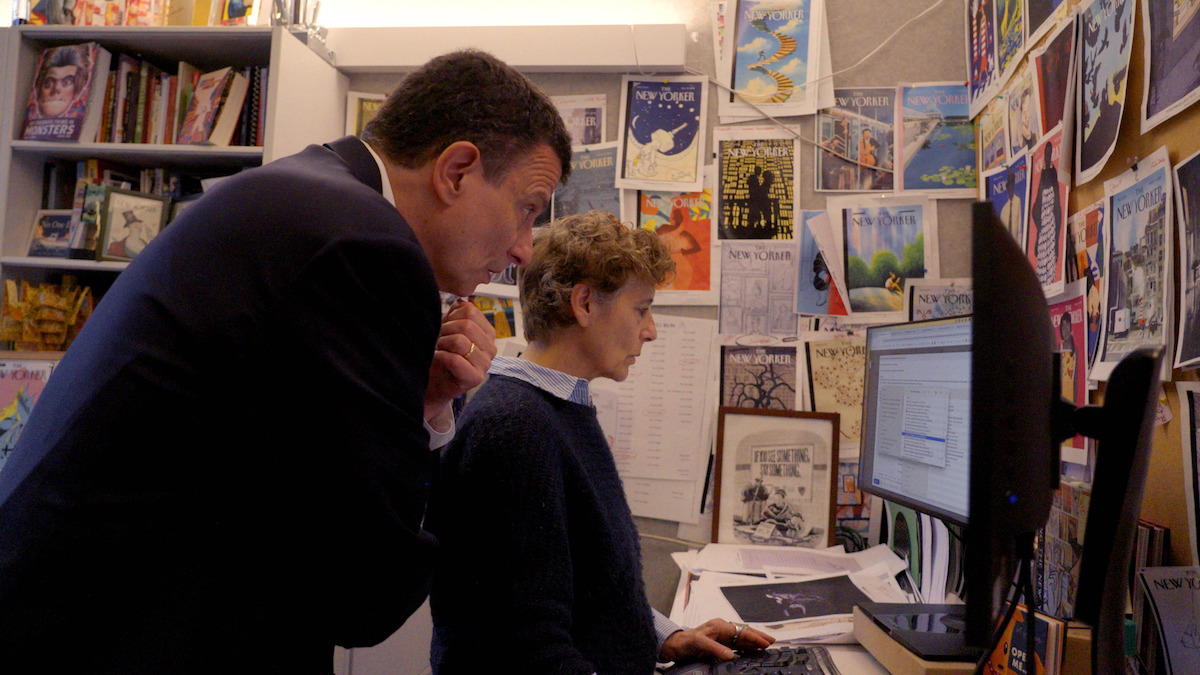
“There’s this thing you learn as a documentary filmmaker,” explains director Marshall Curry, while sitting next to David Remnick, the editor of The New Yorker and one of the subjects of his new film The New Yorker at 100. “You learn to sit quietly and just wait when you ask a question. And eventually the other person will fill that space.” Curry, the documentary filmmaker behind the Academy Award–winning The Neighbors’ Window and the Academy Award-nominated Street Fight, then gets specific about making this documentary with Remnick, who happens to have a Pulitzer Prize for journalism: “I was sitting with David. I asked a question. I sat. He sat. I sat. He sat. Finally David says, ‘I know this trick too.’ ” Remnick offers a kicker to the anecdote: “rook to king’s bishop 4.” The two men laugh, and one gets a sense of the mastery that each brought to this project. Game recognizes game.
Remnick isn’t the only journalist shown at work here. Over the course of the documentary, Curry embeds himself with the writers, editors, critics, cartoonists, fact checkers, essayists, and artists who work on the weekly magazine, which published its first issue on February 21, 1925. The documentary was shot over several months in 2024, as the magazine approaches a milestone anniversary, and while the film — and The New Yorker — reflect the heaviness of the current cultural moment and its implications for journalism pursuits (“it comes at a serious time,” notes Remnick), there is lightness with the dark. “You want the thing that you’re publishing to not only inform and to scrape away the carapace of bullshit and get to the essence of things, but also to relish life in all its absurdity,” says Remnick.
One of the most absurdly funny and beloved aspects of The New Yorker are the legendary cartoons peppered throughout each issue. In the film, longtime staff cartoonist Roz Chast can be seen off the clock, at home with her bird, who also happens to be a fan of the magazine. “She likes The New Yorker. It chews well,” Chast says. Cartoons and the team that works on them are a human embodiment of stress management. “Can we safely agree that the high point [of the film] is of Emma Allen, the cartoon editor, doing Japanese calisthenics in front of her laptop?” asks Remnick.
Woven into the stories of the current staff are flashbacks to notable moments and eras in the print publication’s history, with narration by Academy Award winner Julianne Moore, and testimonials from some of the magazine’s devoted supporters and contributors such as Sarah Jessica Parker, Jon Hamm, Molly Ringwald, Ronny Chieng, and Jesse Eisenberg, who speak to The New Yorker’s cultural impact. But what ultimately distinguishes the magazine — and the team that makes it — is its commitment to truth-seeking journalism and reasonable storytelling. That objective may lead to the impression that it’s a hoity-toity endeavor. “A lot of outsiders think The New Yorker is this stuffy magazine,” Remnick allows. But the staff paints a different picture, revealing that they’re in on the joke, basking in the intersection of serious and tongue-in-cheek. “These people have a sense of humor about what they do and who they are.”
This vision of humanity among journalists is crucial for Remnick and Curry, who say the greatest sign of success is younger audiences appreciating The New Yorker and its enduring legacy — and by association, social justice, prose, politics, and journalism. “It was important to me to say, ‘This work is important, it’s fascinating, it’s a thrilling thing to do,’ ” says Curry. “And the people who do it are —”
Remnick finishes for him: “Hugely fun.”