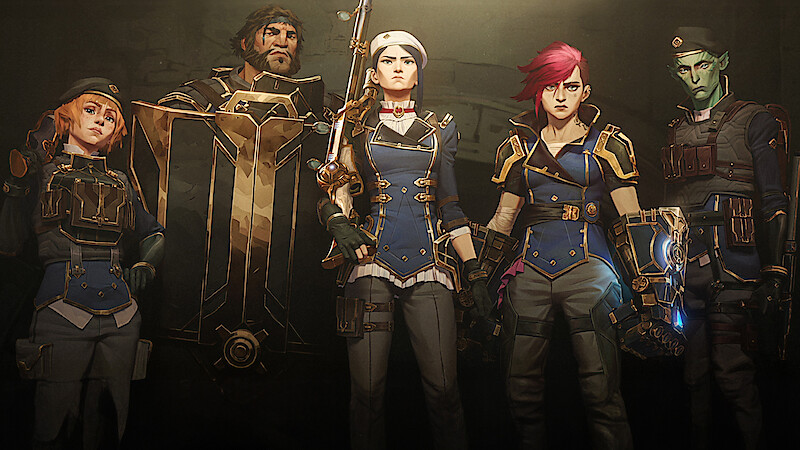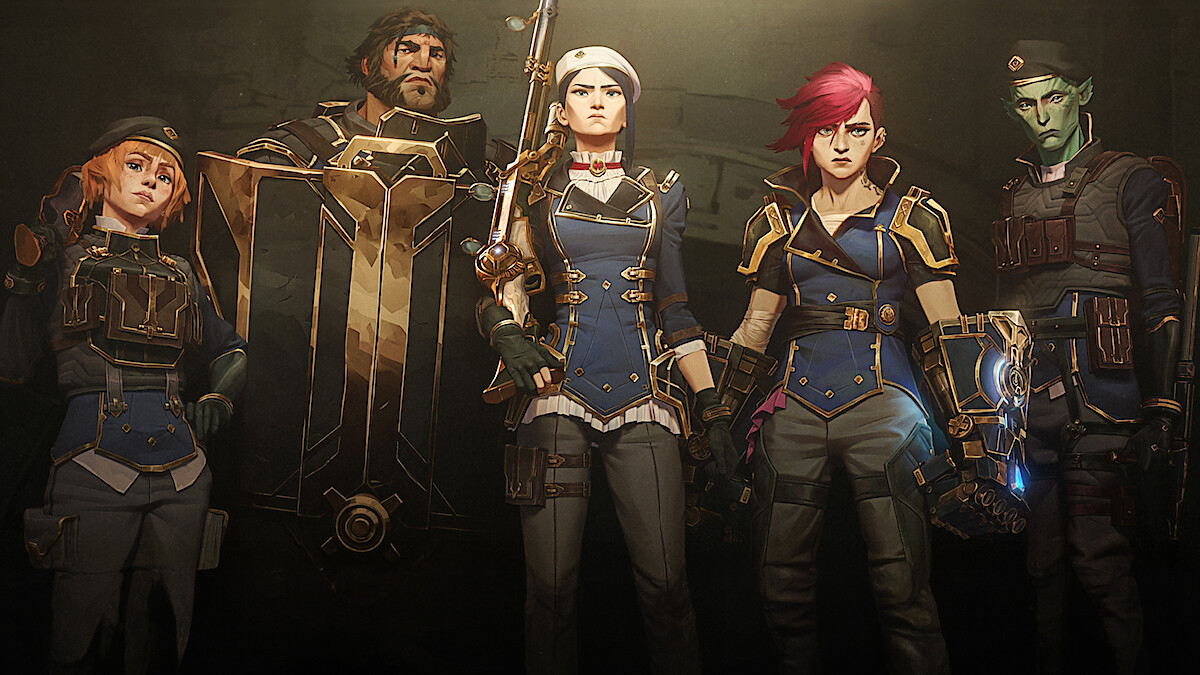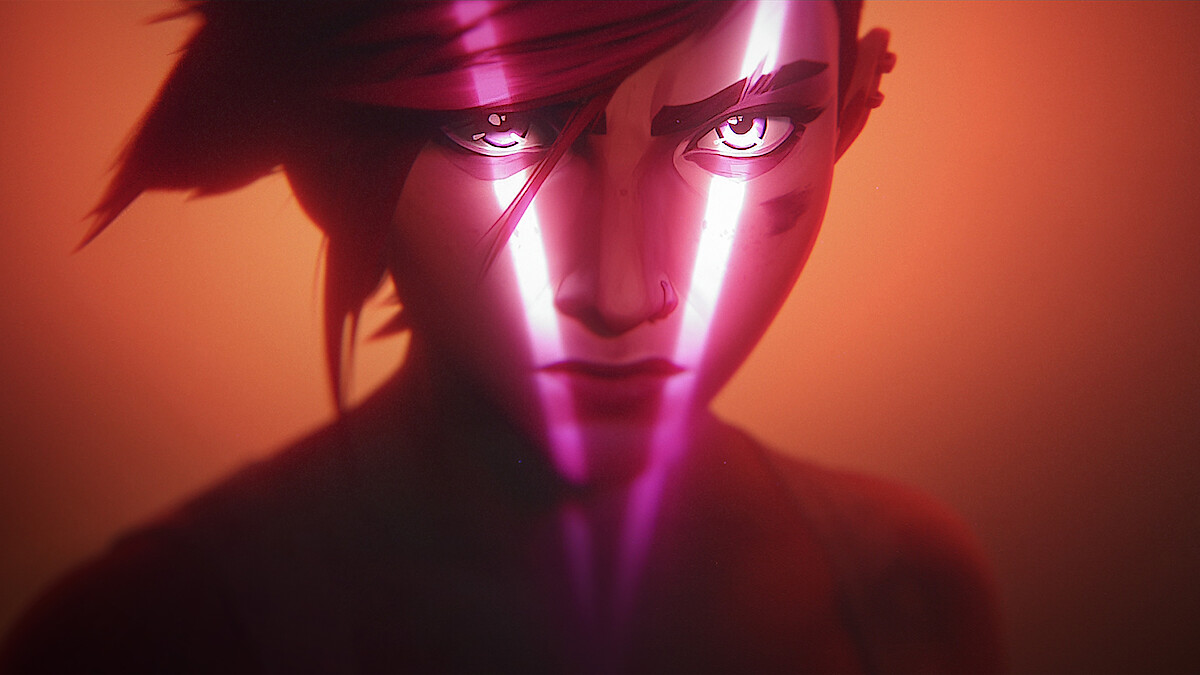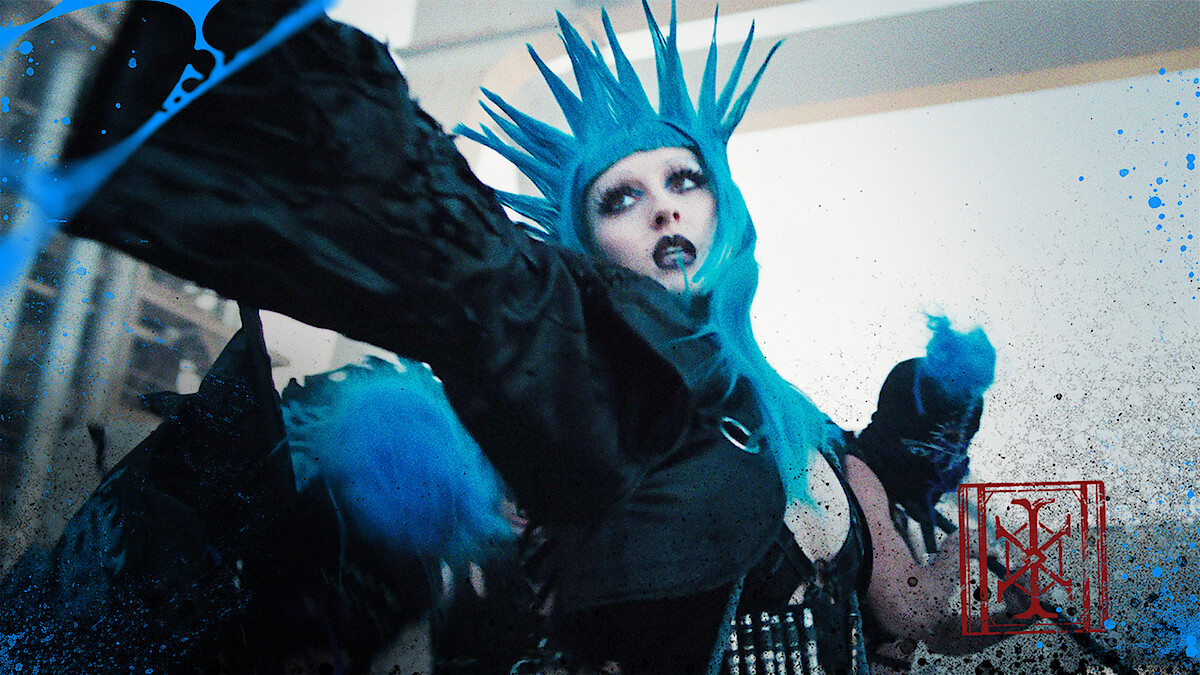
The series’ soundtrack and score will take you to new depths with your favorite champions.
“We tried to bring the viewers to new moods and environments.”
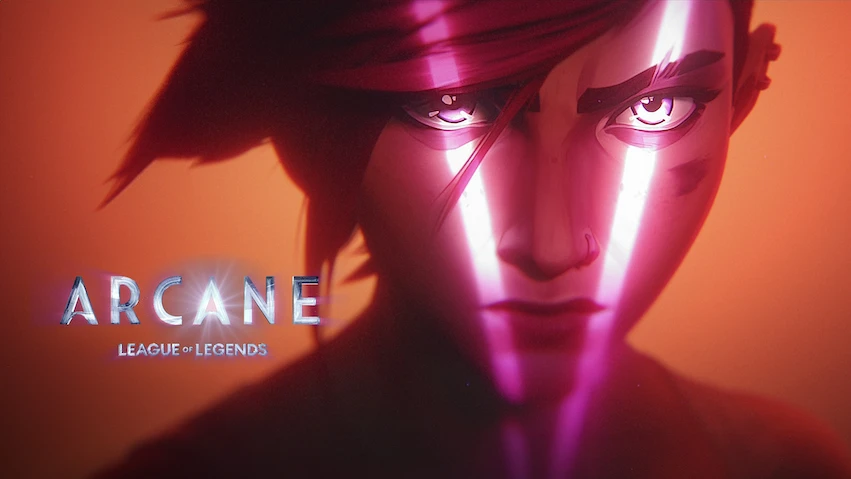
It takes a magical village to make ARCANE — now streaming all Season One and Two episodes on Netflix — look so good on screen.
The Emmy-winning animated series comes from co-creators Christian Linke and Alex Yee, with the French animation studio Fortiche Production in partnership with Riot Games, the minds behind the multiplayer battle game League of Legends, on which ARCANE is based.
Fortiche Production and Riot Games’ collaboration with Linke dates back to 2012, when they first collaborated for the League of Legends “Get Jinxed” character video.
“It’s a professional and friendly relationship spanning more than 10 years,” Fortiche Production co-director Barthelemy Maunoury tells Tudum. “We exchanged daily [communication] with Christian and Alex, and their trust in Fortiche enabled us to work hand in hand.”
While the artists working on Season One focused on building the visual narrative of Piltover and Zaun as two distinctly different cities, Season Two’s visual creatives explored more of the nuances of both cities as they got deeper into the story.
“We tried to bring the viewers to new moods and environments,” Julien Georgel, art director at Fortiche Production, tells Tudum. “We obviously have a lot of dark and sad moments after [Jinx’s attack on the Piltover council], but we’ve also brought some surprises. It’s not all darkness and war.”
The first drawing for Season Two was made just after ARCANE’s November 2021 debut on Netflix, and it took a three-year creative effort to bring the finalized vision to life. That’s partially because a single design can have up to 20 iterations and take anywhere from three weeks to three months to complete.
“Sometimes we fall in love with the energy of the first sketch, but will work for months to keep its essence in the final design,” production designer Arnaud-Loris Baudry tells Tudum.
At the peak of work on the new season, Fortiche Production’s creative team consisted of about 450 artists spread across the US and France. Their expertise touched every aspect of visual artistry, from animation and environments to matte paintings, props, FX, texture, and more.
Keep reading to learn how those Season Two visuals made it from page to screen, as told by the Fortiche experts who worked to bring it all together.
“Smeech’s idea came from creating a yordle that would be linked to Zaun,” Baudry says of the technologically enhanced criminal. “It was an opportunity to show a wacky character who had his body replaced with Chemtech augmentations that allowed him to change size. We thought it would be fun to give him the look of an Alice in Wonderland–inspired character with his top hat, his hairdo, and his Shimmer-infused cigar.”
Baudry adds that while designers like to pitch ideas and options, it’s the animators and directors’ role “to use those ideas to bring the scene to life.”
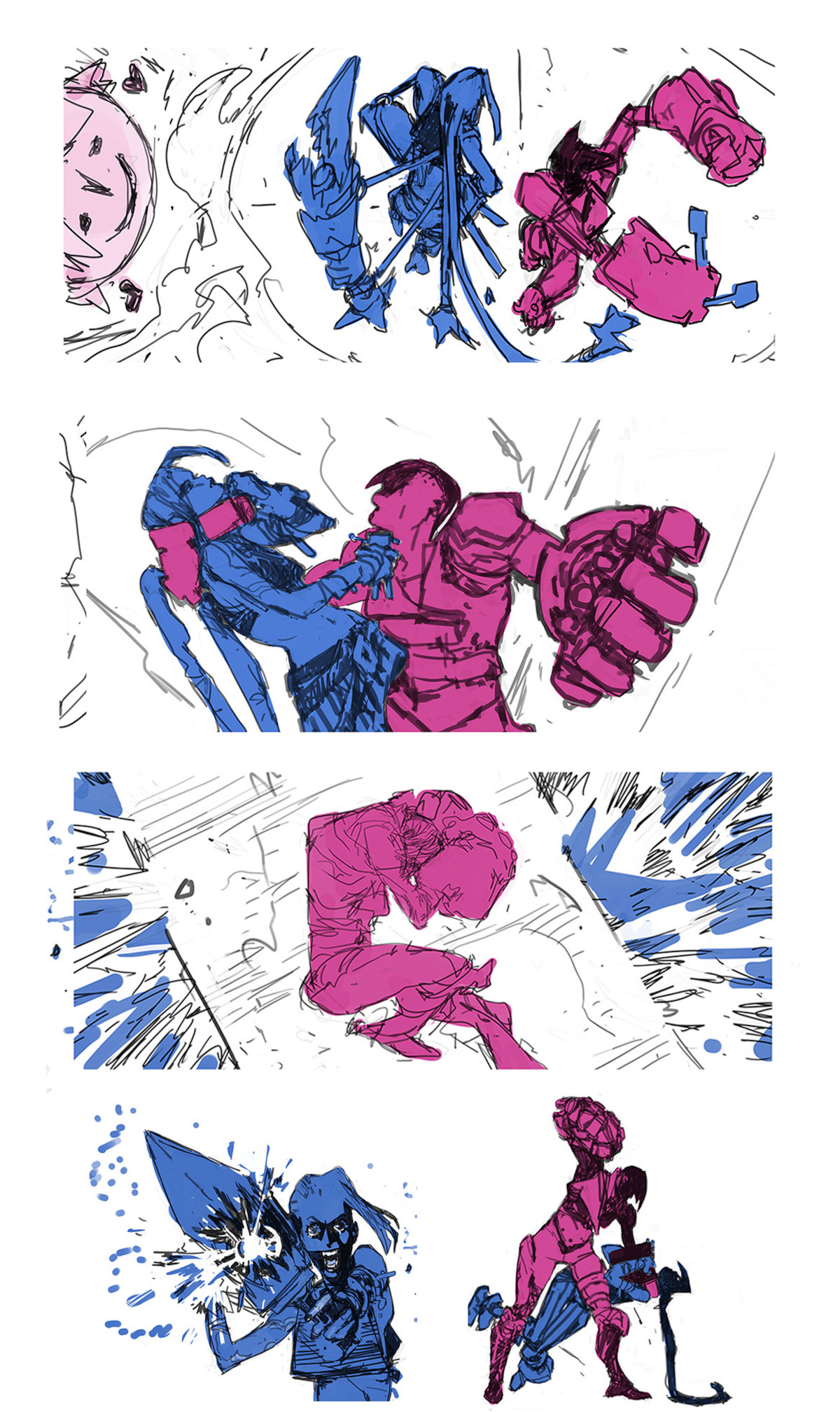
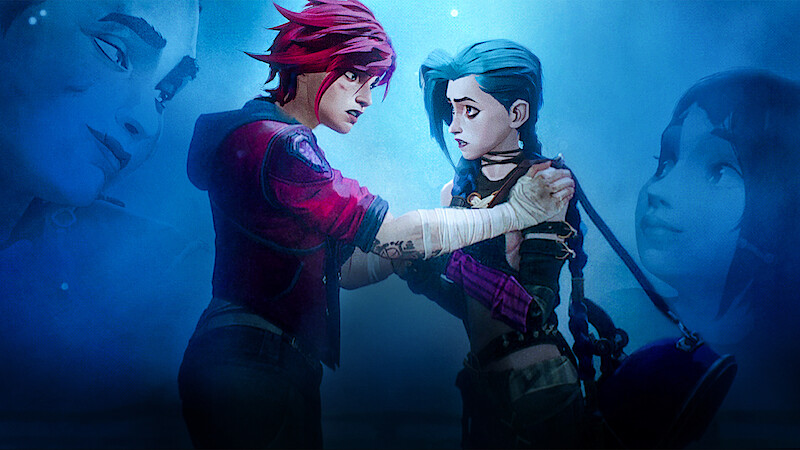
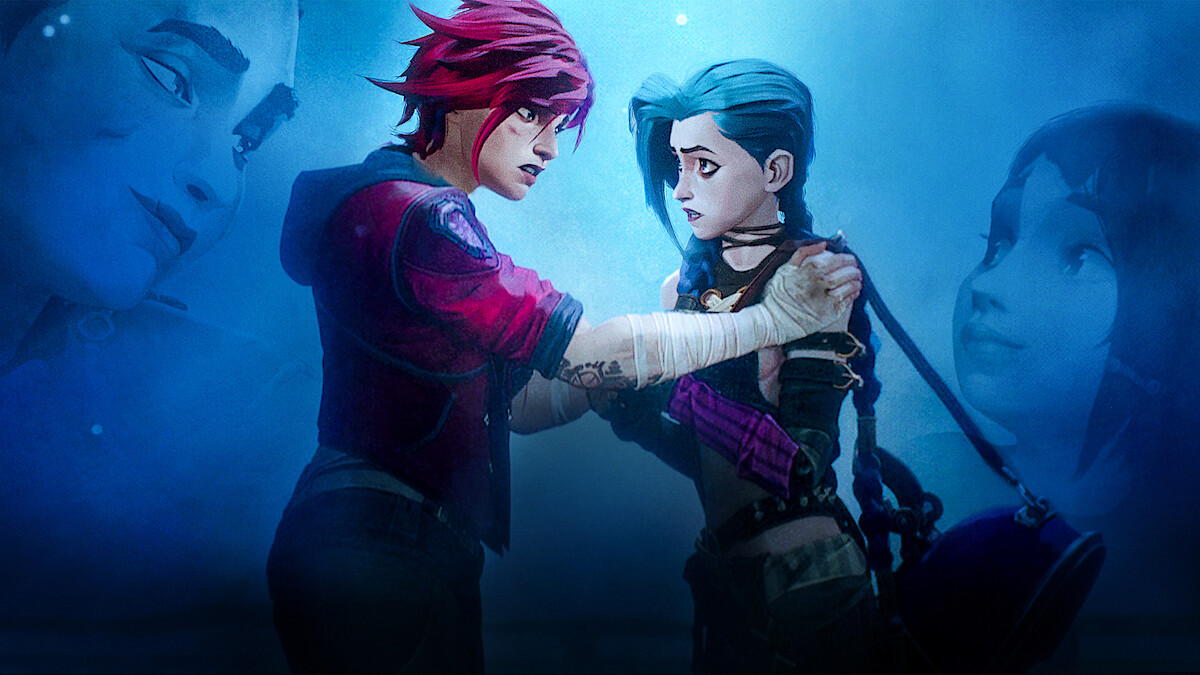
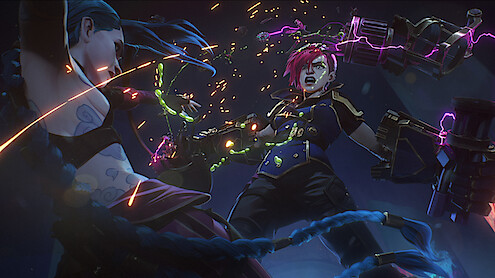
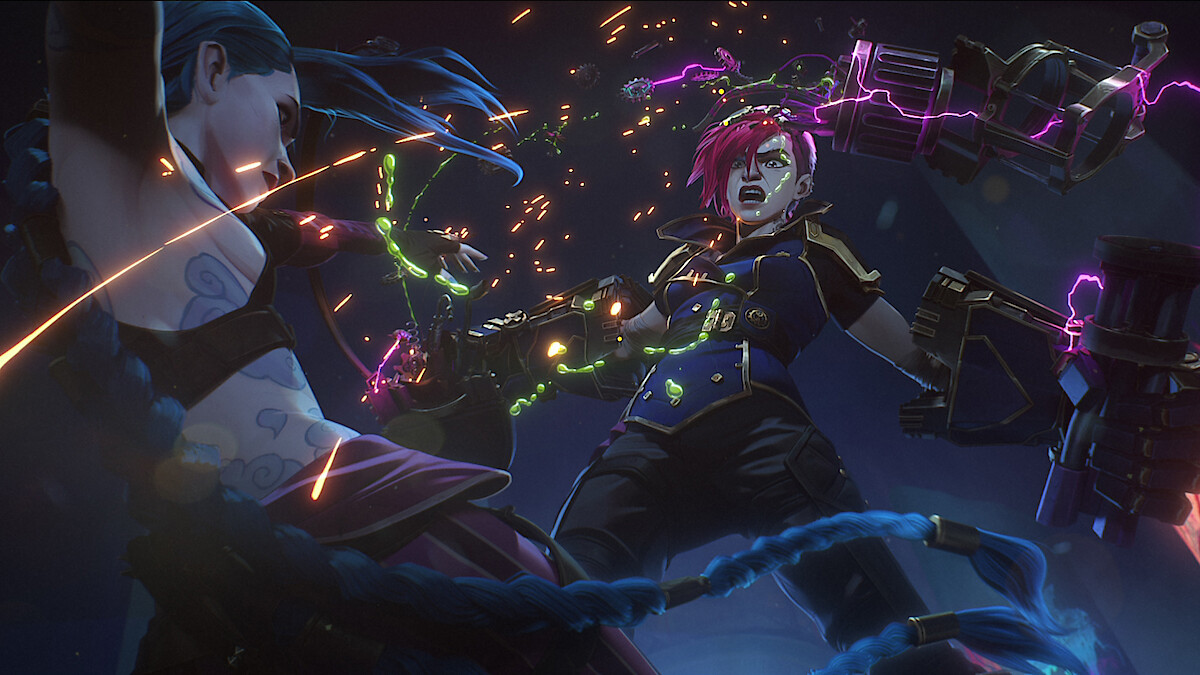
In Season Two, Episode 3, Jinx (Ella Purnell) sets a trap for Vi (Hailee Steinfeld) at the ruins of a temple in the undercity dedicated to the ancient spirit Janna. Vi, believing the old Powder is dead and that Jinx is a stain on her memory, has resolved to fix the problem she created. This leads to a showdown between the sisters at the serene temple surrounded by collapsed gray columns painted with fluorescent graffiti.
“We needed a very neutral and peaceful mood in this ancient temple dedicated to Janna,” Georgel explains. “For us, it’s a canvas [on which] to put the emphasis on those paintings by Jinx, [that shows] the most important moments in her life.”
Baudry adds, “The colorful and fluorescent graffiti contrasts with the calm of the environment. They tell the dramatic story of the two sisters who have been opposed by tragic events.”
Viktor (Harry Lloyd) not only survives Jinx’s attack on the council but gets an upgraded look, which he unveils in the second episode of Season Two. The broken state of his body following that explosion is what allows the Hexcore to turn him into the messiah-like figure we see in later episodes.
“At this stage, the Hexcore has been given the opportunity to heal and transform Viktor’s body and bring him to a place where he can begin to build his church and community,” Georgel explains. “We needed Viktor to look like a human messiah, with a superpositive and peaceful feeling — although his whole body looks like an organic machine made by the Hexcore.”
The design takes some of its cues from his champion skin in League of Legends, but a few enhancements were added for the show.
“In the game, Viktor is a character with an interesting background but a dated design,” Baudry says. “We took the opportunity to revisit the concept of his glorious evolution with a design language linked to transformation through the Hexcore. This is our vision of biomechanical design based on the fusion of his anatomy, his muscle fibers, merging with rigid parts like his corset and the mechanical straps that held his broken body.”
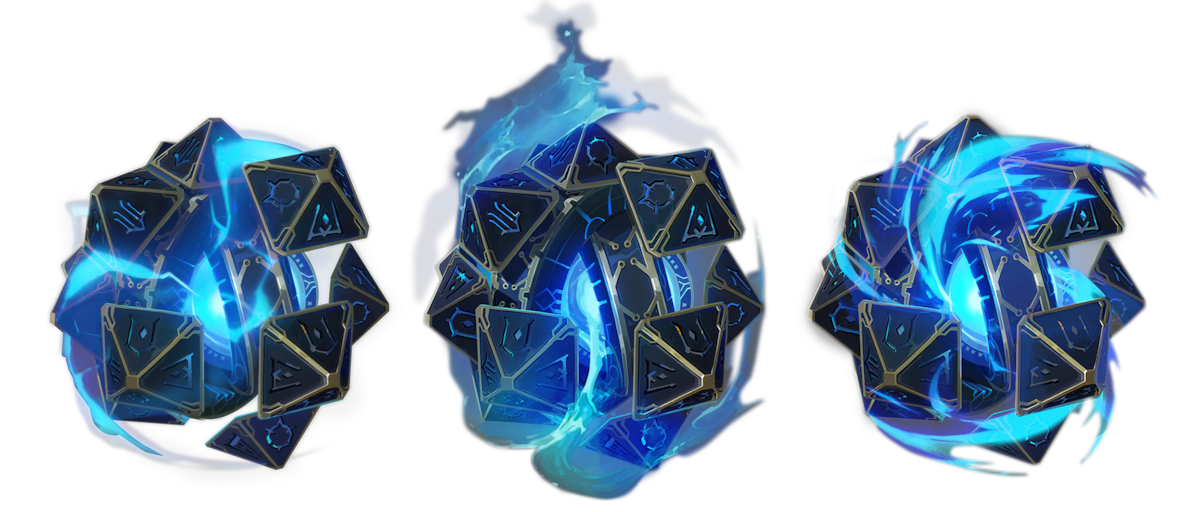
There’s a reason that Jayce (Kevin Alejandro), Ekko (Reed Shannon), and Heimerdinger (Mick Wingert) look horrified in Episode 3, Season Two when they discover Viktor’s anomaly and their reality is distorted. That’s because the spherical creation is a “raw and unstable expression of the arcane,” Georgel says, with a “shape and color language pretty similar to the Hexcore.”
The design features changing, iridescent colors that are “always connected to this ‘pattern of chaos’ enigma Viktor is obsessed with,” Georgel notes. “This spherical anomaly seems to be the source of the energy that’s slowly corrupting the universe. And since Hextech might be drawing energy from that source — or at least it is very connected to it — we can see [that] the Hextech weapons are affected by its instability.”

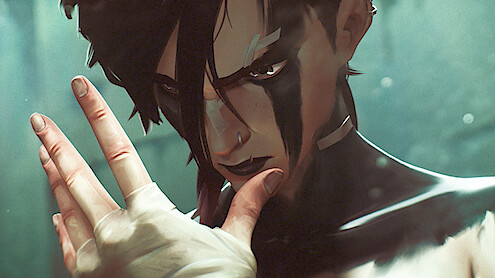
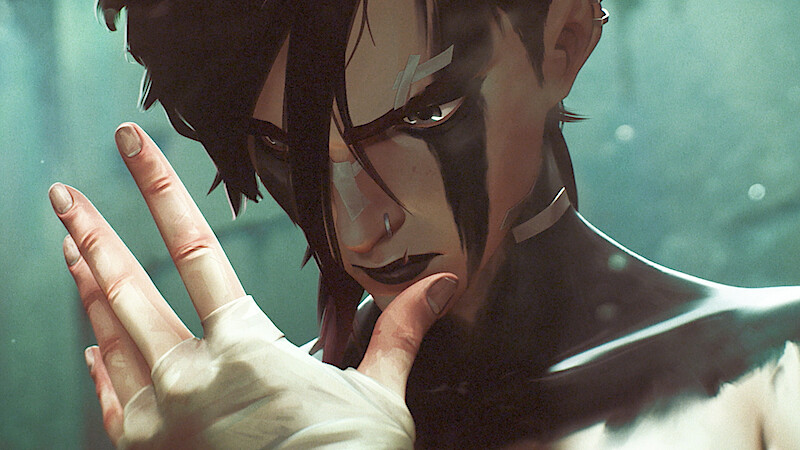
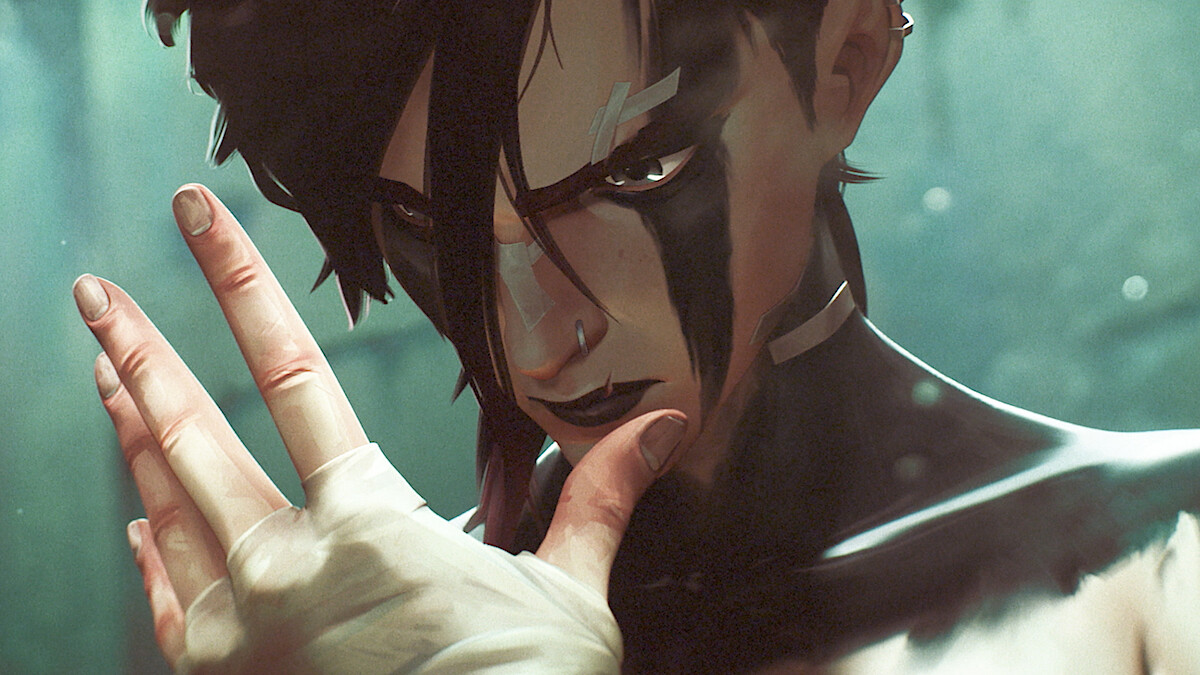
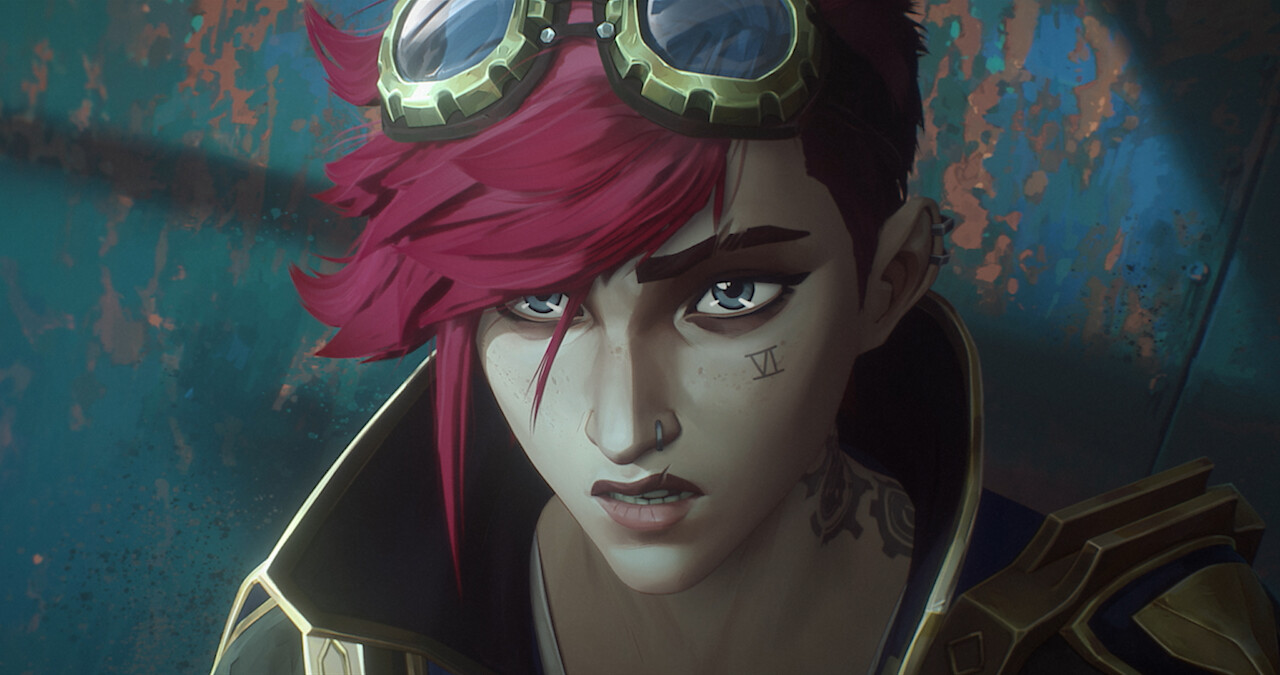
Episode 5 finds Vi caught up in a self-destructive cycle of fighting, excessive drinking, and sleepless nights in the undercity. She’s opted for black hair and grungy makeup, which serves as a visual representation for how she’s feeling on the inside.
After a falling out with both her sister Jinx and friend Caitlyn (Katie Leung), Vi has “lost everything she cared for and does not belong to either Piltover or Zaun,” Baudry says. “We imagined that she would hide her distinctive features — her hair color, her tattoo — and lose herself in the one thing she is good at: fighting.”
“Her life has become very gray and black,” adds Georgel. This “unpleasant yellow in the street and in her makeshift bedroom,” which is the same color as the alcohol she’s overindulging in. He adds, “This super-aggressive and cold white light in the fighting pit … We wanted it to feel dirty, depressive, and violent with these blinking lights in the bar.”
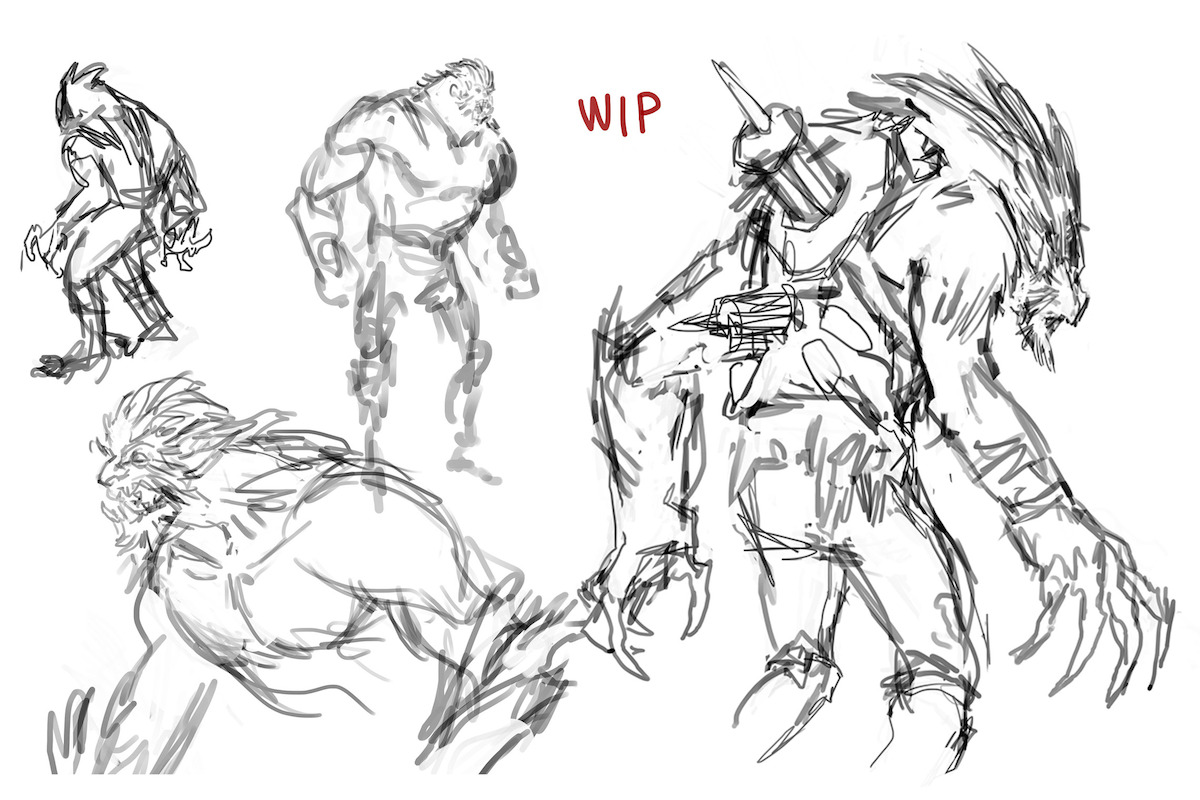
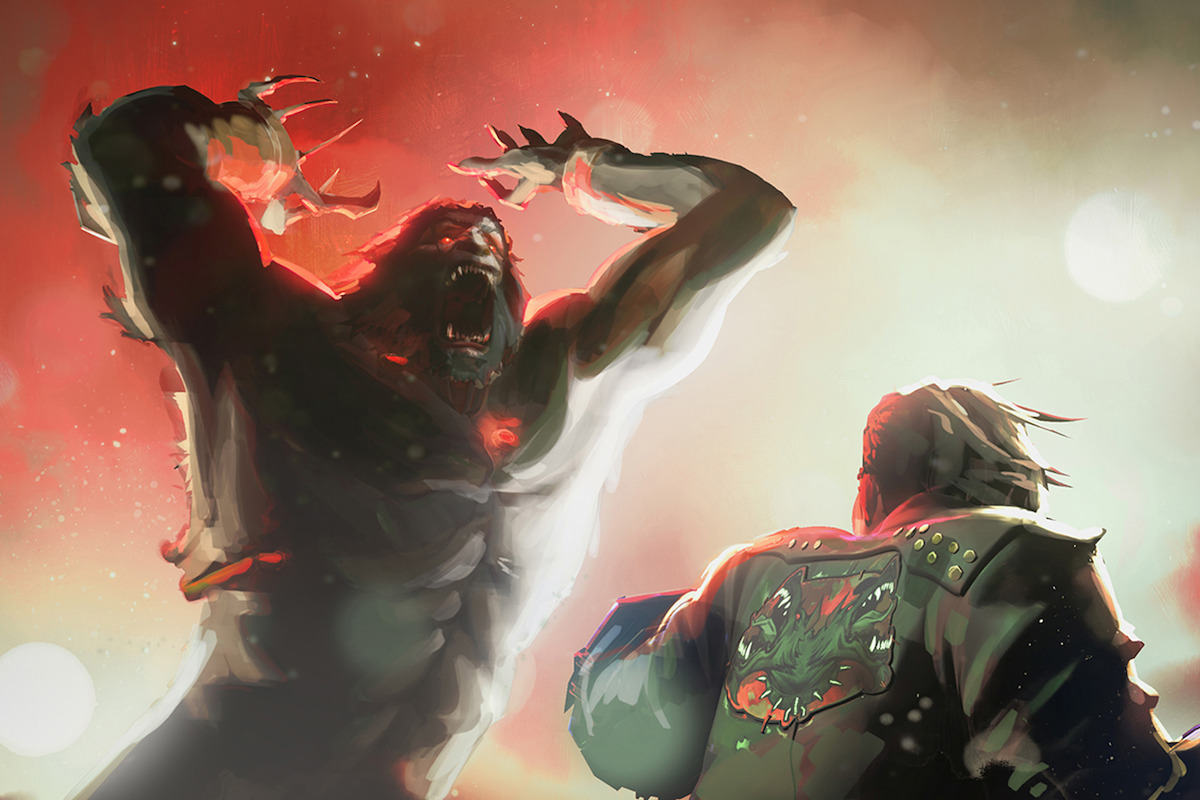
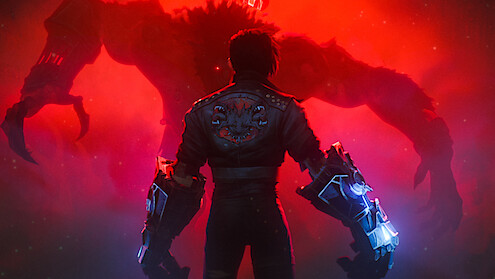
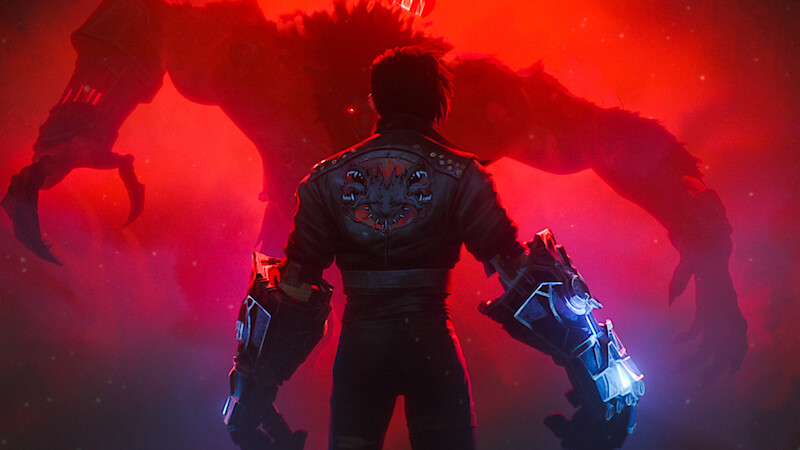
Vander (JB Blanc) is brought back by Singed (Brett Tucker), who turns him into the feral, bloodthirsty beast known as Warwick. Baudry says that Linke, who also serves as showrunner, had the idea early on that Vander would become Warwick.
“We developed Vander’s character during Season One with the idea that he was a particularly resilient person and extremely resistant to suffering,” Baudry says. “It was his skills that allowed Singed to perfect his experience and make him the chimera that is Warwick.”
While Warwick bears a closer resemblance to a werewolf in the League of Legends game, Baudry notes that they “incorporated wild animal elements into his creation and design to evoke his wolf aspect.” The creative team also kept Warwick’s “traits and facial features close to Vander’s” to serve the greater narrative.
One of the inspirations for the design was Alphonse Mucha’s “The Slav Epic,” a series of paintings detailing the story of the Slavic people.
The Slav Epic was used for its “positive, bright and solar mood, and color schemes,” says Georgel. “We wanted to give the impression that we are in the open country with [a] nice blue sky, far away from the oppressive city even though the commune is located in the depths of Zaun.”
Another important aspect of the design, Georgel notes, is that the members of the commune “are all very connected to Viktor’s mind, especially the ones who have been healed by him. The basic structure of everything they build takes its origins from Viktor’s obsession with the anomaly and the Hexcore’s pattern.”
At every scale, from the “smaller details to the whole structure of the village itself” you can see a bit of that distinct spiral, a fractal, iridescent pattern.
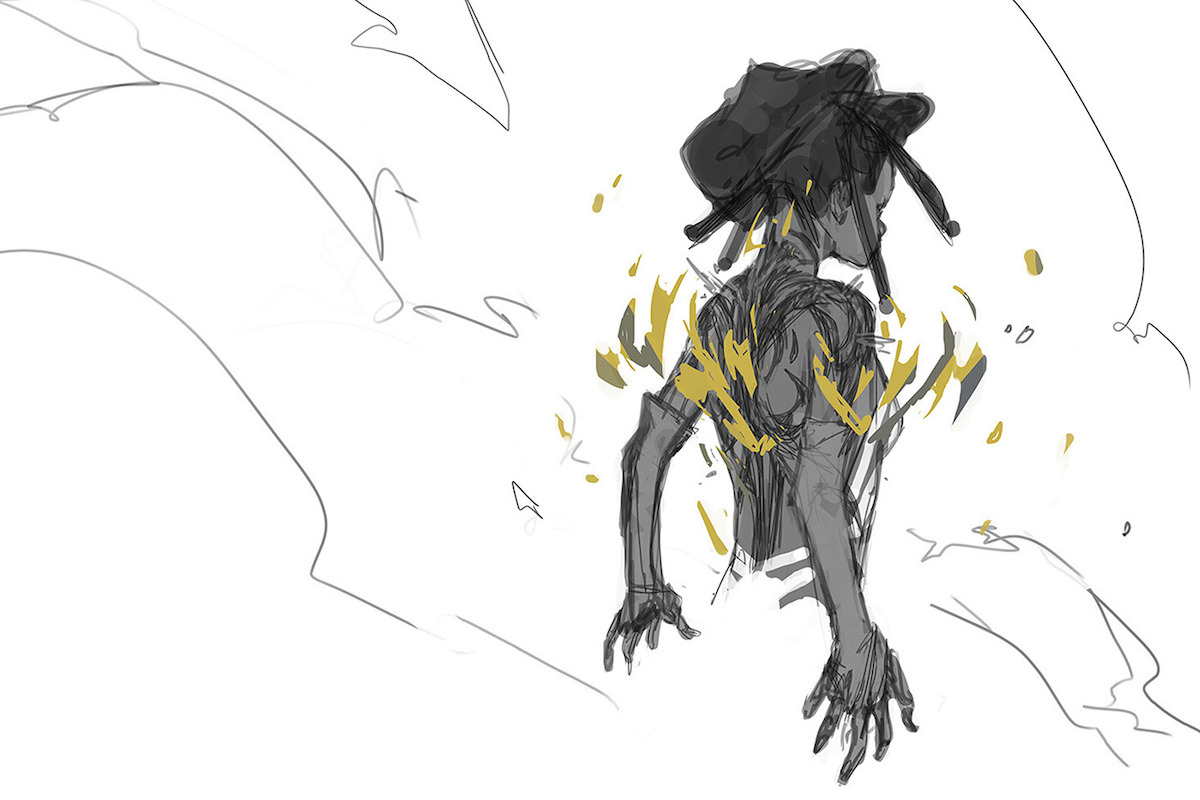
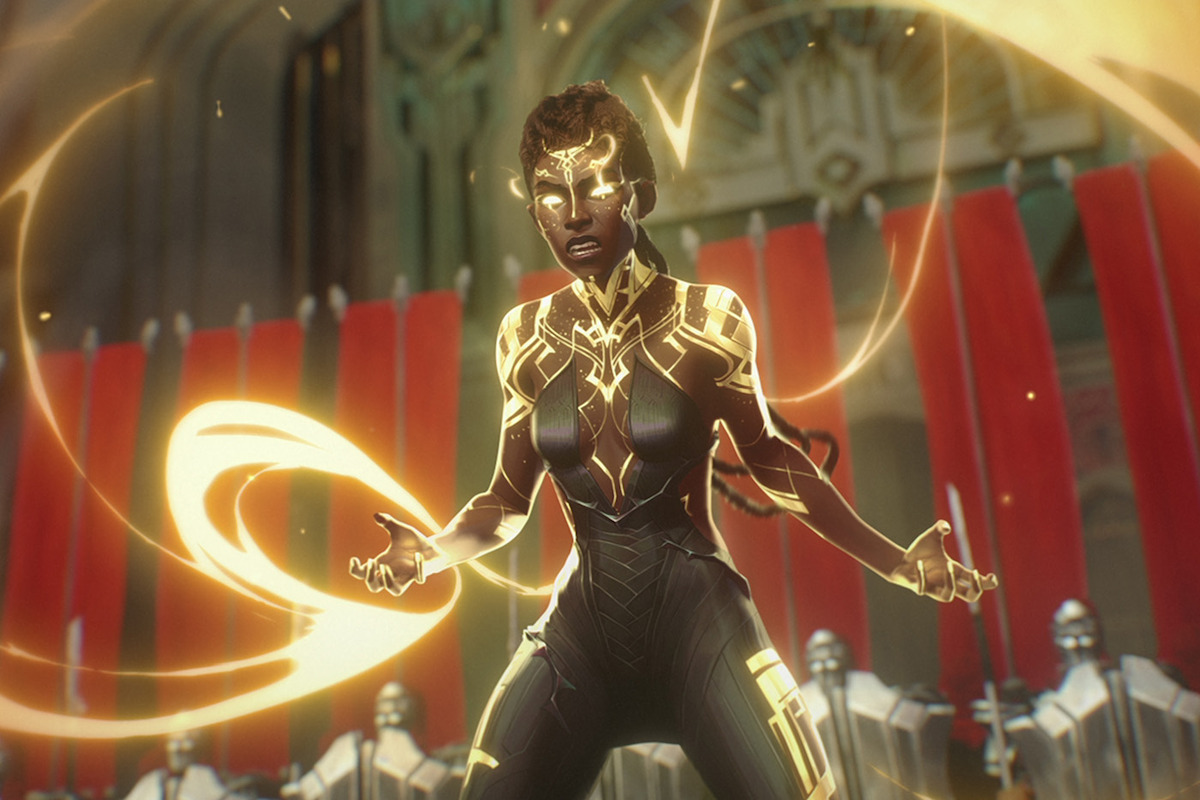
In Episode 8, Mel (Toks Olagundoye) walks away from her encounter with the Black Rose sorceress (Minnie Driver) with a fresh look to match her newly discovered mage magic.
“For the reveal of her mage look, we wanted a very simple and clean costume, both elegant and impressive,” Baudry notes.
Mel isn’t exactly thrilled about becoming a mage and disguises herself with a billowy white cloak. Baudry says, “As she finds herself away from Piltover, we wanted to make it feel like she had traveled and was hiding in her new costume.”
When she taps into her power, as we see in Episode 9, the shapes of her magic are “based on the golden tattoos on her body,” says Georgel.
A rejuvenated Ekko swoops into action in Episode 9 with a “prototype of his iconic Z Drive” as well as an “improvised weapon made from a clock hand that evokes his iconic bat,” says Baudry.
Ekko is not yet the champion we meet in League of Legends, but his look in the ARCANE series finale is a send-up of who he’ll later become.
“Ekko is a character that our fans love, but we knew he wouldn’t have all his abilities by the time of the finale,” Baudry explains. “We wanted to show the potential of the boy savior, the genius with the potential to defy time.”
Throughout ARCANE, Ekko wears his signature green and orange colors along with a white hourglass symbol painted on his head. Baudry notes that for his Episode 9 design, they wanted “to connect [Ekko] visually to Jinx,” so that both characters’ distinctive looks resonated with each other.
“The color palette of this costume of Ekko is mixed with Jinx’s color palette,” Baudry adds. “There are visual elements and graffiti that [call back to] their fight in Season One.”
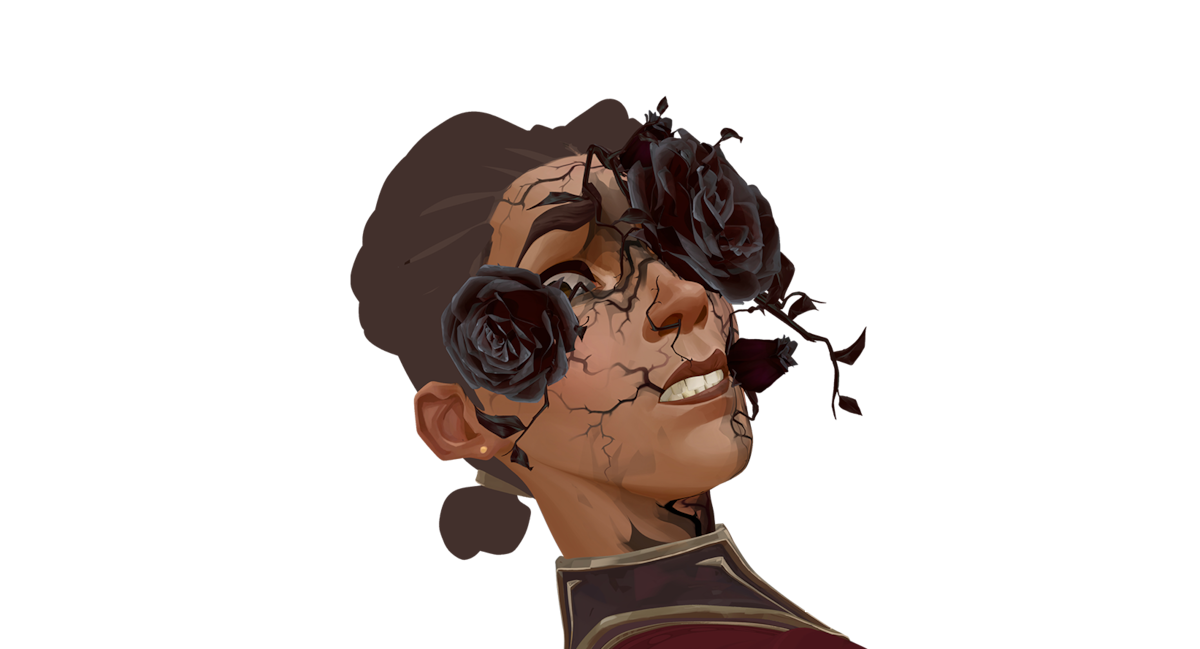
Runes, Hextech, Chem-tech, and Shimmer are all different forms of magic with their own distinct color palettes. When it came to introducing Black Rose magic in Season Two, Georgel says the team “wanted to find a new color palette and shape language to make it feel uncanny and dangerous.”
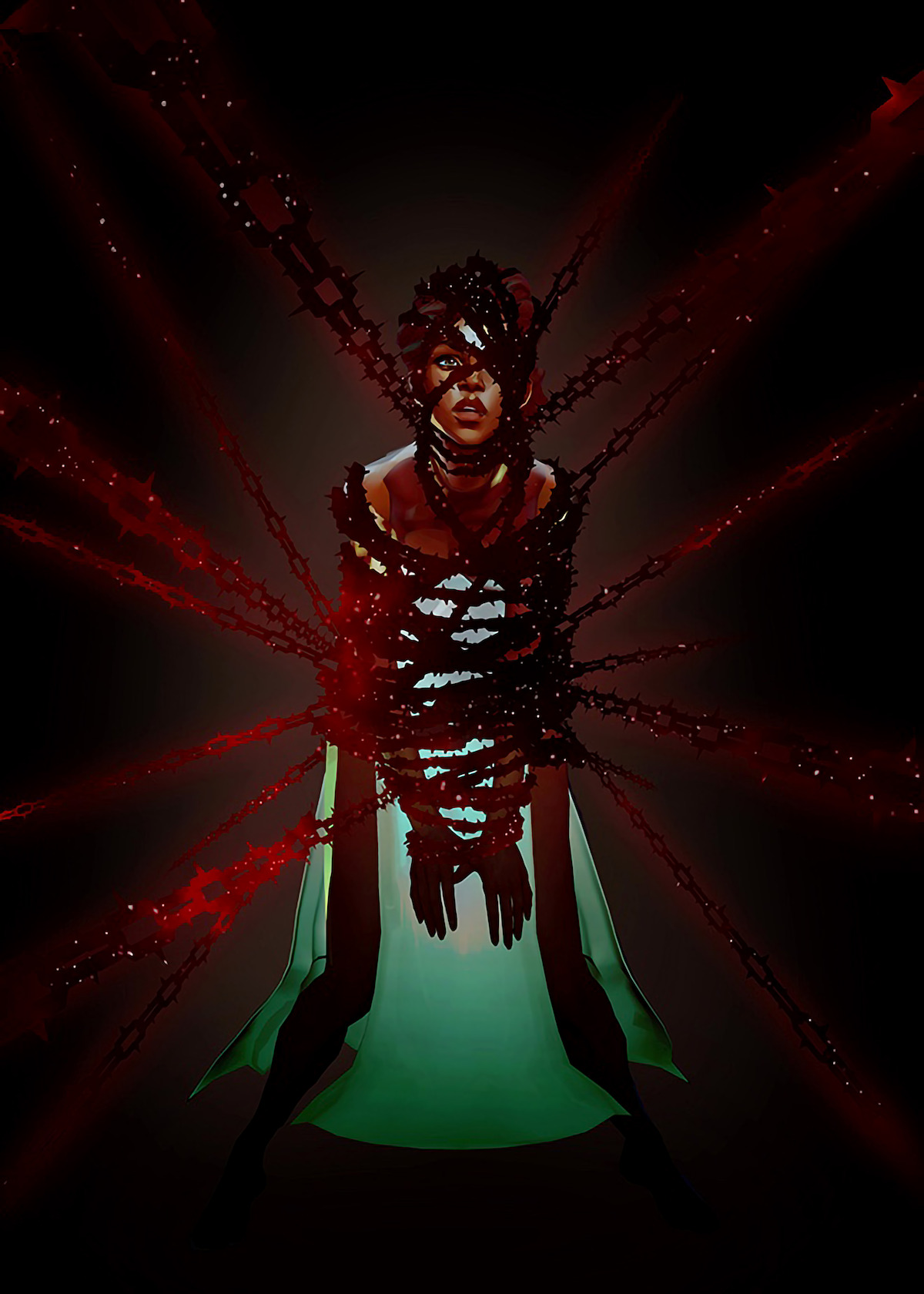
The Black Rose’s mental prison takes on a red and black color scheme — complete with thorny black chains emitting a red glow — which creates a harsh environment that leaves Mel visibly uncomfortable.
“We wanted those chains to look magical,” Baudry notes, adding that the chains are not physical. In Episode 8, Mel is kept in a mind-prison but isn’t physically restrained. Rather, she’s “immobilized in the center of a pentagram-looking Black Rose device, and her mind is projected into a mental illusory prison.”
The design itself didn’t evolve much from the original concept. “We worked at the same time on Episodes 3 and 5 hand in hand with the character designers for Amara and Elora,” Baudry adds. “The FX and compositing team did nearly all the work to make it look good.”
It took “years of work” to create the colossal battle you see in the series’ final act, Baudry reveals.
“We designed the entire second season around this decisive battle between all the factions we followed — the inhabitants of Zaun, Piltover, the Jinxers, the followers of Viktor, the Noxians,” Baudry notes.
As part of his “glorious evolution,” Viktor extends his cosmic mental link beyond his followers to those involved in the showdown at the Hexgates, including Jayce, Vi, Mel, Sevika (Amirah Vann), Warwick, and Jinx. “It is an epic moment, but we wanted it to remain human and intimate,” Baudry says.
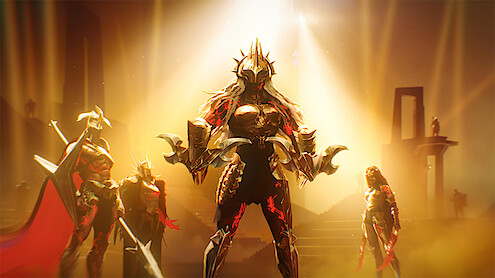
The final look for “Super Viktor” is a complex design that took “more than four years of visual development,” Baudry adds. “It has its own design language, which evolves as the season progresses; as he evolves, transforms, and ultimately loses [his] humanity.”
ARCANE Seasons One and Two are now streaming on Netflix.